Showing posts sorted by relevance for query bob fuller. Sort by date Show all posts

Three Jolly Miners - Vocalion 15087 (1925)

From wikipedia...

Bob Fuller (b. c. 1898) was an American blues and jazz saxophonist and clarinetist, best known for his recordings accompanying female singers of the 1920s.

Born and raised in New York City, Fuller toured the United States with Mamie Smith, then settled down to extensive studio work. He was a house saxophonist for Ajax and Victor Records, playing with Elmer Snowden and Louis Hooper. These musicians also recorded on their own, including as the Five Musical Blackbirds. Fuller also played with Fats Waller's combo, Six Hot Babies.

Fuller worked on at least 140 sessions between 1920 and 1928, accompanying singers such as Martha Copeland, Helen Gross, Rosa Henderson, Maggie Jones, Viola McCoy, and Monette Moore.

Among his many 1920's recordings, his trio sides (with piano and banjo) were issued as "Three Hot Eskimos", "The Black Diamonds", "Three Jolly Jesters", and "Three Monkey Chasers".

Fuller left music permanently after he was sent to prison in the 1930s.

Louis Stanley Hooper (May 18, 1894, North Buxton, Ontario - September 17, 1977, Charlottetown, Prince Edward Island) was a Canadian jazz pianist.

Hooper was raised in Ypsilanti, Michigan and attended the Detroit Conservatory, where he played locally in dance orchestras in the 1910s. He then moved to New York City around 1920; he recorded with Elmer Snowden and Bob Fuller frequently in the middle of the decade, and performed with both of them in Harlem as well as with other ensembles. Hooper served for some time as the house pianist for Ajax Records and accompanied many blues singers on record, including Martha Copeland, Rosa Henderson, Lizzie Miles, Monette Moore, and Ethel Waters. He participated in the Blackbirds revue of 1928.

In 1932 Hooper returned to Canada, where he played in Mynie Sutton's dance band, the Canadian Ambassadors. He did local work solo and in ensembles for the next two decades, then was brought back into the limelight by the Montreal Vintage Music Society in 1962. Hooper released an LP of ragtime piano tunes in 1973 entitled Lou Hooper, Piano. He taught at the University of Prince Edward Island late in his life and appeared regularly on CBC television in Halifax.

His papers, which include unpublished compositions and an autobiography, are now held at the National Library of Canada in Ottawa.

Elmer Snowden (October 9, 1900 – May 14, 1973) was a banjo player of the jazz age. He also played guitar and, in the early stages of his career, all the reed instruments. He contributed greatly to jazz in its early days as both a player and a bandleader, and is responsible for launching the careers of many top musicians. However, Snowden himself has been largely overlooked in jazz history.

Born in Baltimore, Snowden is remembered today mainly as the original leader of the Washingtonians, a group he brought to New York City from the capital in 1923. Unable to get a booking, Snowden sent for Duke Ellington, who was with the group when it recorded three test sides for Victor that remain unissued and are, presumably, lost. Ellington eventually took over leadership of the band,[1] which contained the nucleus of what later became his famous orchestra. Snowden was a renowned band leader – Count Basie, Jimmie Lunceford, Bubber Miley, "Tricky Sam" Nanton, Frankie Newton, Benny Carter, Rex Stewart, Roy Eldridge and Chick Webb are among the musicians who worked in his various bands.

Very active in the 1920s as an agent and musician, Snowden at one time had five bands playing under his name in New York, one of which was led by pianist Cliff Jackson. Unfortunately, most of his bands were not recorded, but a Snowden band that included Eldridge, Al Sears, Dicky Wells and Sid Catlett appeared in a 1932 film, Smash Your Baggage. Snowden also made numerous appearances as a sideman on almost every New York label from 1923 on. Unfortunately, he rarely received credit, except for two sides with Bessie Smith in 1925, and six sides with the Sepia Serenaders in 1934.

Though Snowden continued to be musically active throughout his life, after the mid 1930s he lived in relative obscurity in New York. He continued to play throughout the 30s, 40s and 50s, but was far from the limelight. After a dispute with the musicians union in New York, he moved to Philadelphia where he taught music, counting among his pupils pianist Ray Bryant, his brother, bassist Tommy Bryant, and saxophonist Sahib Shihab (Edmond Gregory).

Snowden was working as a parking lot attendant in 1959 when Chris Albertson, then a Philadelphia disc jockey, came across him. In 1960, Albertson brought Snowden and singer-guitarist Lonnie Johnson together for two Prestige albums, assembled a quartet that included Cliff Jackson for a Riverside session, Harlem Banjo, and, in 1961, a sextet session with Roy Eldridge, Bud Freeman, Jo Jones, and Ray and Tommy Bryant—it was released on the Fontana and Black Lion labels.

In 1963, his career boosted, Snowden appeared at the Newport Jazz Festival. He toured Europe in 1967 with the Newport Guitar Workshop. He moved to California to teach at the University of California, Berkeley, and played with Turk Murphy.

In 1969, Snowden moved back to Philadelphia, where he died on May 14, 1973.

Bob Fuller cl / Louis Hooper p / Elmer Snowden bj.

Recorded in New York on August 8, 1925.


Bob Fuller - Diva 2580 (1925)

Here's another Bob Fuller post to start the year.

The last one can be seen here.

Bob Fuller cl / Louis Hooper p / Elmer Snowden bj.

Recorded in New York on March 4, 1925.


Thomas Morris & His Orchestra / New Orleans Blue Five - Victor 20316 (1926)

Thomas Morris c, speech / Charlie Irvis tb, speech / Bob Fuller cl / Mike Jackson p.

Recorded in New York on August 27, 1926.


Thomas Morris c / Joe Nanton tb / Bob Fuller cl, ss / Mike Jackson p / Buddy Christian g / Helen Baxter, Thomas Morris, Joe Nanton dialogue. 

Recorded in New York on November 2, 1926.

Three Monkey Chasers - Harmony 23 (1925)

Here's the latest addition to the growing Bob Fuller collection.

Bob Fuller cl / Isadore Meyers p / Elmer Snowden bj.

Recorded in New York on August 20, 1925.

.

Elizabeth Smith / Alberta Hunter (With Fats Waller) - Victor 21539 (1927)

Not sure what Rex Stewart's debut recording was but I believe it to be in 1926. This side can't be too far removed from that.

Elizabeth Hunter v / Rex Stewart c / Ernest Elliott, Bob Fuller cl / f / ? Phil Worde p.

Recorded in New York on January 26, 1927.


Alberta Hunter v / Thomas Waller or.

Recorded at Church Studio in Camden, NJ on May 20, 1927.

Nashville Jazzers - Madison 50001 (1927)

Here we have the Nashille Jazzers' lone recording...but not the lone recording by this core trio.

Victor 20316 & Conqueror 7081.

Tom Morris c / Bob Fuller cl / as / Mike Jackson p / bj.

Recorded in New York in 1927.

Original Jazz Hounds - Columbia 14207 (1927)

From wikipedia…

Louis Metcalf (February 28, 1905 - October 27, 1981) was a jazz cornetist and trumpeter. He played for a short time with Duke Ellington for which he is best remembered.

Metcalf was born in Webster Groves, Missouri. As a youth he first trained on the drums but switched over to cornet permanently. As a teenager in St. Louis, Missouri he played with Charlie Creath.

Metcalf moved to New York City in 1923 and participated in the fertile jazz scene there, playing with such legends as Willie "The Lion" Smith, Jelly Roll Morton, Benny Carter and King Oliver. In 1926 Duke Ellington hired Metcalf to play in his seminal orchestra, where his mellow tone contrasted with Bubber Miley's. In the 1930s Metcalf led his own bands and joined Fletcher Henderson's.

In 1946 Metcalf moved to Montreal and formed the International Band, the first to play the nascent bebop style in Canada. Under his leadership the Café Saint-Michel was the hub of the jazz scene in Montreal for a few years, with local musicians such as the young Oscar Peterson and visiting Americans such as Art Pepper, Fats Navarro and Sonny Rollins sitting in with the band.

A drug bust prompted Metcalf to return to New York City in 1951. He released an album entitled "I've Got The Peace Brother Blues" in 1966 where he demonstrates that his style had indeed evolved since his days with Ellington. Metcalf was less active after falling ill in 1968 and died in 1981.

Louis Metcalf c / Jake Frazier tb / Bob Fuller cl / James P. Johnson p / bj / ? Harry Hull bb / d, chimes / Perry Bradford v.

Recorded in New York on March 15, 1927.


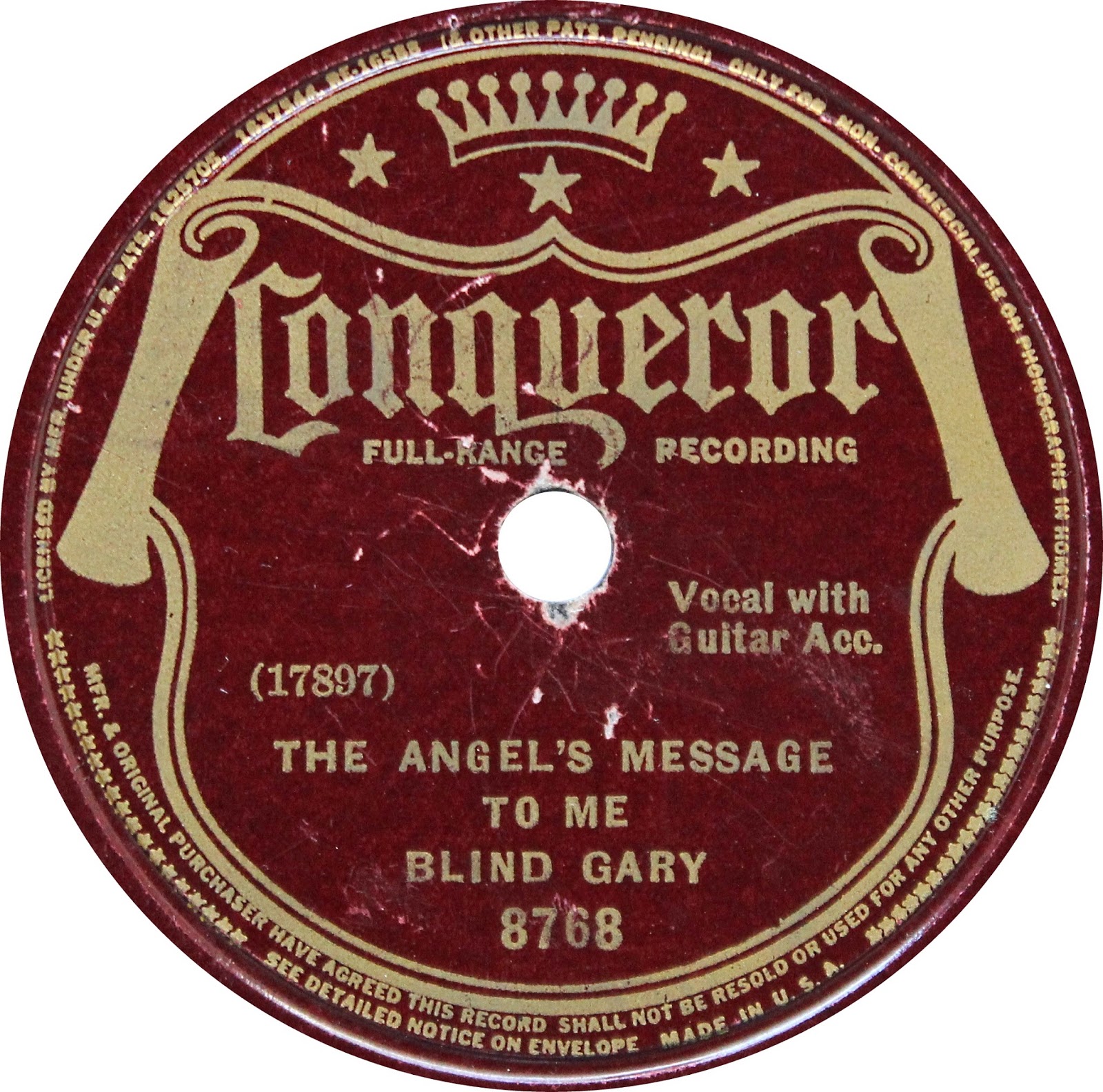
Blind Gary - Conqueror 8768 (1935)

From wikipedia...

Reverend Gary Davis, also Blind Gary Davis, (April 30, 1896 – May 5, 1972) was a blind African American blues and gospel singer and guitarist, who was also proficient on the banjo guitar and harmonica.

Gary Davis was born in the Piedmont region of the country, in Laurens, South Carolina, and was the only one of eight children his mother bore who survived to adulthood. He became blind as an infant. Davis reported that his father was killed in Birmingham, Alabama, when Davis was ten, and Davis later said that he had been told that his father had been shot by the Birmingham High Sheriff. He recalled being poorly treated by his mother and that before his death his father had given him into the care of his paternal grandmother.

He took to the guitar and assumed a unique multi-voice style produced solely with his thumb and index finger, playing not only gospel, ragtime, and blues tunes, but also traditional and original tunes in four-part harmony.

In the mid-1920s, Davis migrated to Durham, North Carolina, a major center for black culture at the time. There he taught Blind Boy Fuller and collaborated with a number of other artists in the Piedmont blues scene, including Bull City Red. In 1935, J. B. Long, a store manager with a reputation for supporting local artists, introduced Davis, Fuller, and Red to the American Record Company. The subsequent recording sessions marked the real beginning of Davis' career and are available in his Complete Early Recordings. During his time in Durham, Davis converted to Christianity; in 1937, he would be ordained as a Baptist minister. Following his conversion and especially his ordination, Davis began to express a preference for inspirational gospel music.

In the 1940s, the blues scene in Durham began to decline and Davis migrated to New York. In 1951, several years before his "rediscovery", Davis's oral history was recorded by Elizabeth Lyttleton Harold (the wife of Alan Lomax) who transcribed their conversations into a 300+-page typescript.

The folk revival of the 1960s re-invigorated Davis' career and included a performance at the Newport Folk Festival and having Peter, Paul and Mary record his version of "Samson and Delilah", also known as "If I Had My Way", which is originally a Blind Willie Johnson song that Davis had popularized. "Samson and Delilah" was also covered and credited to Davis on the Grateful Dead's "Terrapin Station" album. Eric Von Schmidt credits Rev. Davis with three-quarters of Schmidt's Baby, Let Me Follow You Down which Bob Dylan covered on his debut album for Columbia. Blues Hall of Fame singer and harmonica player Darrell Mansfield has also recorded several of Rev. Davis' songs.

Davis died in May 1972, from a heart attack in Hammonton, New Jersey. He is buried in plot 68 of Rockville Cemetery in Lynbrook, Long Island, New York.

Recorded in New York on July 26, 1935.